
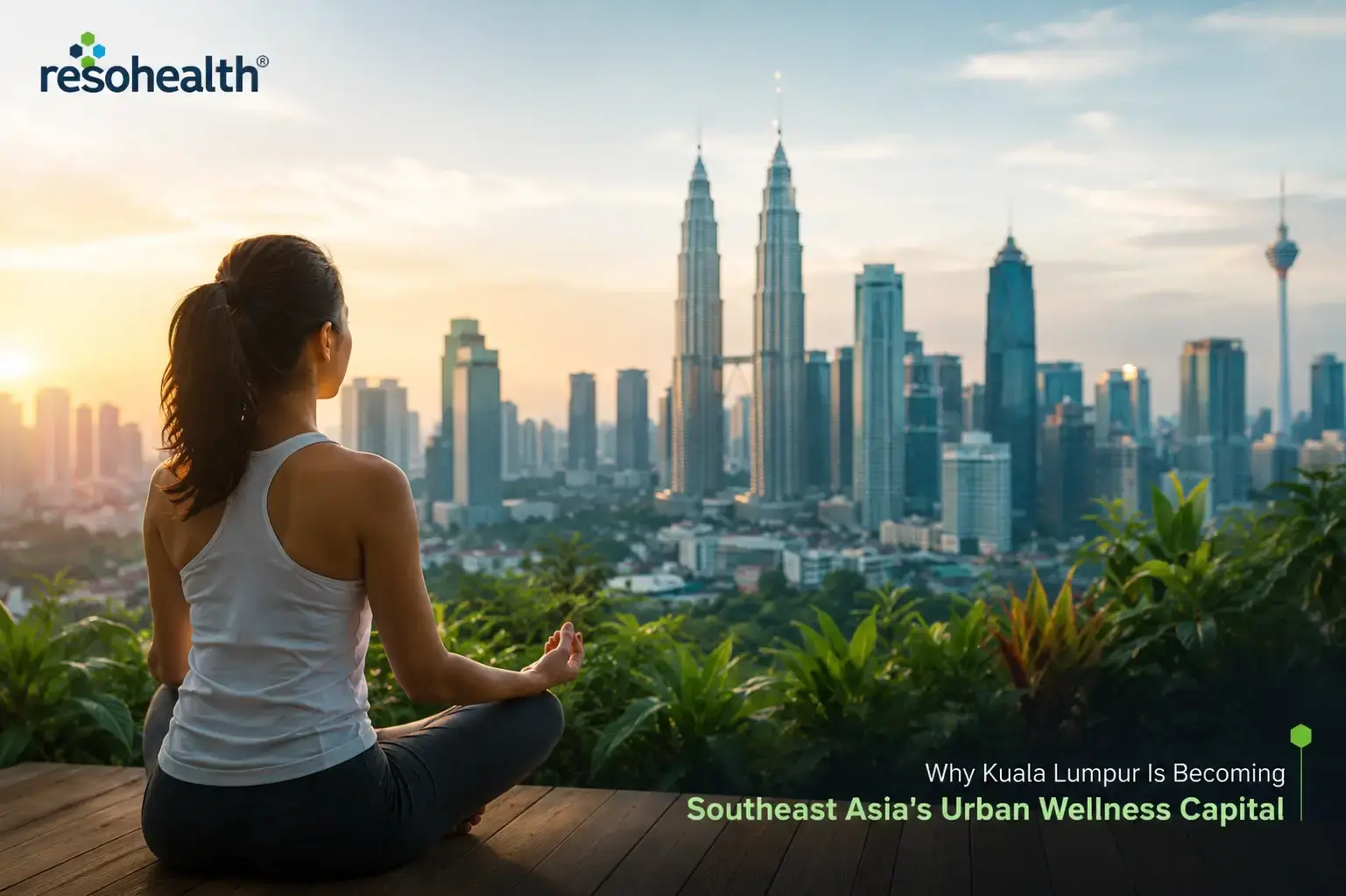

A city that surprises people
Most international visitors think of Kuala Lumpur as a stopover — the city you pass through on the way to Bali or Phuket. That’s starting to change. KL has spent the last decade building a wellness infrastructure that now rivals cities twice its size, and it’s doing it with something most wellness destinations can’t offer – a genuine cultural depth alongside the facilities.
Where Kuala Lumpur actually is
Kuala Lumpur sits roughly two degrees north of the equator in Peninsular Malaysia, about 350 kilometres north of Singapore. It’s the capital and largest city of Malaysia, with a metropolitan population of around seven million.
The city is at a low elevation — mostly flat — surrounded by forested hills to the north and east that rise to 1,000–1,500m within an hour’s drive to beautiful limestone caves around. The Titiwangsa mountain range forms the city’s eastern backdrop. It’s a short car drive to the top of mountains and the weather is tropical and humid.
KLIA (Kuala Lumpur International Airport) is one of the better-connected airports in Southeast Asia — direct flights from Dubai run about seven hours, from London about 13 hours, and from Singapore 45 minutes. Malaysia Airlines, AirAsia, and Emirates all serve the route from Dubai.
The culture
KL is genuinely multicultural. The Malaysian population is roughly 70% Malay, 23% Chinese, 7% Indian, with significant indigenous and other communities. All major religious traditions — Islam, Buddhism, Christianity and Hinduism — are actively practised and visible in the city’s architecture, food, festivals, and daily rhythm.
The result is a city where the call to prayer, the sound of a Chinese temple gong, and a Hindu festival procession can all occur in the same neighbourhood on the same day. For a visitor arriving from a more monocultural environment, this plurality is one of KL’s most distinct qualities.
The food
KL’s food scene is frequently described as one of the best in Asia — by food writers, chefs, and visitors who’ve eaten their way through the region. The diversity is the point: Chinese hawker food, Malay kampung cooking, Indian banana-leaf rice, Peranakan cuisine, and a modern restaurant scene that draws on all of these without abandoning any of them.
For health-focused visitors, the options are exceptional. The Peranakan tradition — a fusion of Chinese and Malay cooking — produces complex, aromatic dishes built on fresh herbs, coconut, and slow cooking. It is a must for travellers to try the Peranakan Cuisine and Traditional Malay kuehs (malay desserts) and Malay cuisine.
The modern wellness food scene has expanded rapidly in areas like Bangsar, Damansara, and TTDI — high-quality plant-based restaurants, smoothie bars, and functional nutrition cafes that rival Canggu (Bali) in quality but often at lower prices.
The wellness infrastructure
KL’s wellness scene has developed quickly in the last five years. Premium fitness studios (Barry’s, F45, CrossFit), breathwork facilitators, float therapy centres, traditional Chinese medicine clinics, Ayurvedic centres, and corporate wellbeing providers are now well-established in the city.
What makes KL distinct from other urban wellness cities is the access to nature that doesn’t require leaving the city entirely.
Resohealth has established partnership with Amana Biohacking Club, which is located in the heart of the KL city and it is an unique CEO biohacking club that offers a wide range of scientifically proven biohacking activities.
If you are a high performer and want to take a short break to energise and boost your performance, join us for the 8 days retreat that is happening on the 24 September – 2 October. Where you get to experience the new biohacking club access along with other like-minded individuals.
Checkout the Retreat page for more information on our Letsgo KL Reset that is power packed with activities spread across 8 days.
The LetsGo KL Reset uses KL’s urban wellness infrastructure and surrounding hills to deliver the same 8-day protocol as the Bali Reset — adapted for city-based high-performers.